
A Clear Business Case for SSCI Regenerative Agriculture Criteria.

By: Anna Solic Moore and Lia Hayman
The regenerative agriculture concept is gaining momentum, but without a clear path, it risks becoming vague marketing rather than a credible route to climate & nature-resilient farming. We need to cut through the noise and align on harmonised messaging on what supply chain actors require from a robust regenerative agriculture standard. This is why the Consumer Goods Forum’s Sustainable Supply Chain Initiative (SSCI) and Peterson Solutions are collaborating to develop minimum required criteria to cover regenerative agriculture programmes.
The Consumer Goods Forum (CGF) and the SSCI are launching a public consultation on Minimum Requirements for Regenerative Agriculture Programmes, a framework that establishes what credible regenerative agriculture standards should deliver at field level. This is the result of a collaborative effort between Peterson Solutions and the SSCI, bringing together two organisations committed to bringing clarity to sourcing policies and supporting long-term supply chain resilience.
The problem: why clarity matters
The global regenerative agriculture market is currently valued at USD 11.3 billion and is expected to grow by over 11% in the next few years. Farmers are adopting new practices to build resilience and sustain crop yields, and companies want to prove their commitments to soil health, carbon sequestration, biodiversity, and farmer livelihoods.
But without consensus on what “regenerative” means operationally, we’re seeing:
- Vague claims without measurement or verification
- Inconsistent expectations across supply chains
- Isolated practices that don’t deliver systemic ecosystem improvement
- Disconnects between sustainability promises and actual implementation
The industry needs a north star, and we invite your feedback via the public consultation to help determine it. The aim is to provide an assurance and benchmarking framework to evaluate sustainability programmes that audit, monitor and certify regenerative agricultural practices.
The output
Together, we:
- Analysed 12 voluntary standards and private programmes claiming regenerative credentials
- Held 16 stakeholder engagement calls across the value chain, including retailers, manufacturers, biotechnology, academia, advocacy groups, and standard owners, to capture real-world implementation realities
- Understood the current landscape of regenerative agriculture voluntary standards and private programmes, identifying where commonalities and gaps exist across leading programmes
- Developed 8 core criteria that set out what makes a regenerative agriculture standard robust, credible, and effective
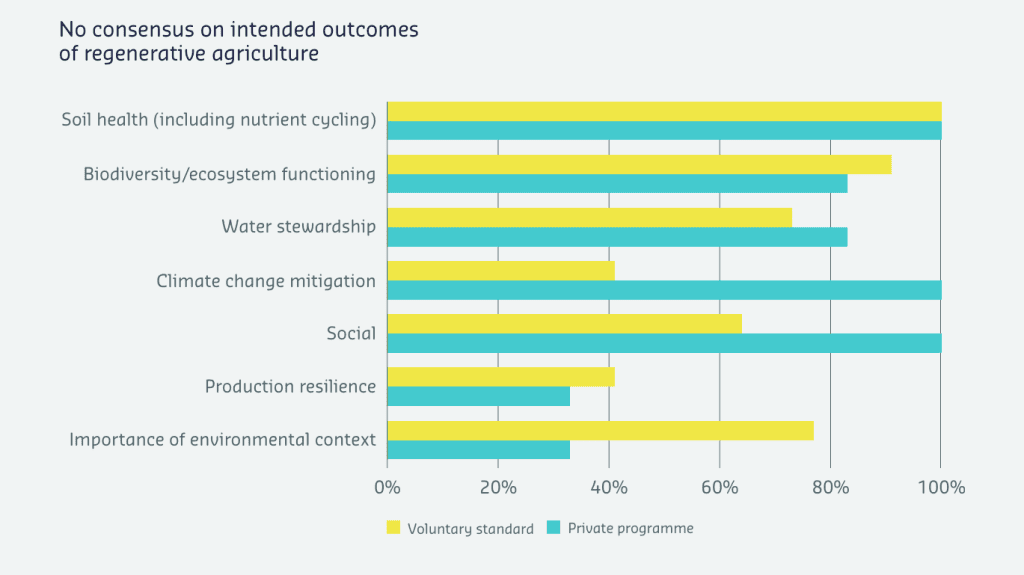
What the data revealed: key findings
Our joint research uncovered surprising consensus, and some important gaps:
Soil is central. 100% of the standards we analysed put soil health as a central keystone. That’s not accidental; it’s essential. Regenerative agriculture positions soil as the principal gateway to improving the functioning of ecosystems.
Improvement is iterative, not binary. 97% of stakeholders agreed that ongoing improvement is central to regenerative agriculture. It’s a journey, not a destination.
Context matters enormously. 71% of standards accommodate local ecological conditions, including crop type, soil chemistry, climate, and rainfall. One-size-fits-all mandates are not appropriate for regenerative agriculture and allow farmers to be at the heart of implementing tailored solutions for their land.
Farmer livelihoods are underoperationalised. Here’s the disconnect: 62% of stakeholders agree that farmer wellbeing should be central to regenerative agriculture. 67% of standards reference livelihood benefits. Yet only 4% actually monitor it.
Outcomes require evidence. Regenerative agriculture claims demand high-quality, verifiable data. Monitoring systems, adaptive management, and ongoing improvement aren’t optional. They’re essential to credibility.
The 8 minimum requirements
Our joint work sets out draft minimum criteria that any voluntary standard claiming to be ‘regenerative’ should meet. These criteria are a draft, and we invite everyone to comment on them:
- Whole-Farm Approach: Regenerative principles must be applied across the entire farm system, not limited to individual fields or crops
- Importance of Context: Practices must be selected and adapted to local ecological and climatic conditions and crop requirements
- Multiple Practices: Standards should require at least three complementary regenerative practices at farm level, not single silver bullets
- Farmer Livelihoods: Standards must support the long-term economic resilience and wellbeing of farmers, not just ecosystem metrics
- Ongoing Improvement: Regeneration is an ongoing process of reviewing and adjusting practices, not a fixed performance threshold
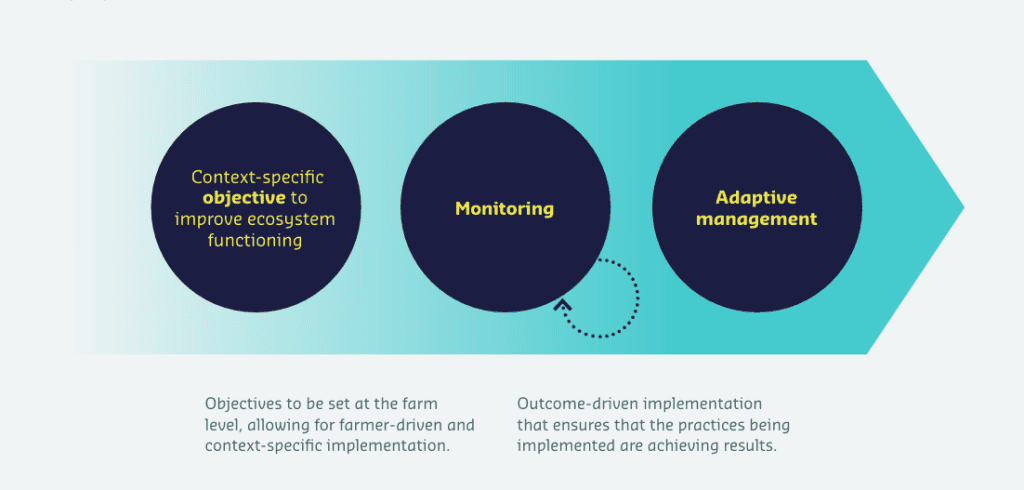
- Improvement of Ecosystem Functioning via the Soil: Farms should set objectives to measurably improve ecosystem functioning, using soil as the primary entry point
- Monitoring of the Environment: A farm-level monitoring system must track progress toward improved soil health and wider ecosystem functioning
- Adaptive Management: Monitoring results should inform management decisions that target the farm’s weakest areas
What happens next
We’ve released this as a public consultation because your feedback is critical to getting this right. The criteria we’ve developed are a starting point, not a finished product. We need input from industry to ensure these standards are practical, achievable, and truly reflect what credible regenerative agriculture should look like. After the public consultation, the SSCI will consider the next steps for these criteria.
Why you should get involved
The standards and criteria that emerge from this process will influence procurement decisions, certification requirements, and investment in regenerative practices for years to come. Your insights can help us build a framework that is practical and fit for purpose.
How to get involved
The public consultation is open from 14 to 28 October 2026. We invite you to review the draft criteria and share your feedback by completing this fifteen-minute survey by 28 October 2026.
Download the full report
This overview captures the headline findings, but the details matter. The full report includes:
- The methodology behind the research and stakeholder engagement
- Detailed findings and data on practices, monitoring and farmer livelihoods
- Key limitations, including trade-offs, land ownership, KPI tracking and contractual constraints
- The complete draft criteria, with further guidance, implementation evidence examples and justification
Download: Minimum Requirements for Regenerative Agriculture Programmes
Our collaboration
Peterson Solutions brings on-the-ground implementation experience and expertise in standard development and sustainability governance. The SSCI specialises in benchmarking voluntary standards across global supply chains. Together, we combine that practical and governance expertise with the credibility of one of the world’s most trusted standard-setting frameworks.