
Digital Product Passports: Why Battery Data Will Be the Real Test of Readiness

By: Ruben Martinez
For many companies, the Digital Product Passport still sounds like a technology project. In reality, the bigger challenge starts much earlier: having the right product data, from the right sources, with enough evidence to trust it.
Under the EU Batteries Regulation, from 18 February 2027, a battery passport will be required for every one of the following batteries placed on the EU market or put into service:
- Light means of transport (LMT) batteries
- Industrial batteries with a capacity above 2 kWh
- Electric vehicle (EV) batteries
The obligation falls on the economic operator that places the battery on the market, meaning companies need to understand their role and responsibilities well before the deadline.
The passport will bring together information about the battery model as well as data specific to the individual battery, including information generated throughout its use and lifecycle.
That information is not limited to a product description. Requirements cover areas such as material composition, carbon footprint, responsible sourcing, recycled content, performance and durability, state of health and the battery’s status throughout its lifecycle.
With February 2027 approaching, the question is no longer whether companies should start preparing. It is whether they have enough visibility across their value chain to be ready when the obligation applies.
So what should companies focus on now?
Start with the data behind the battery
A battery passport is only as reliable as the information that feeds it.
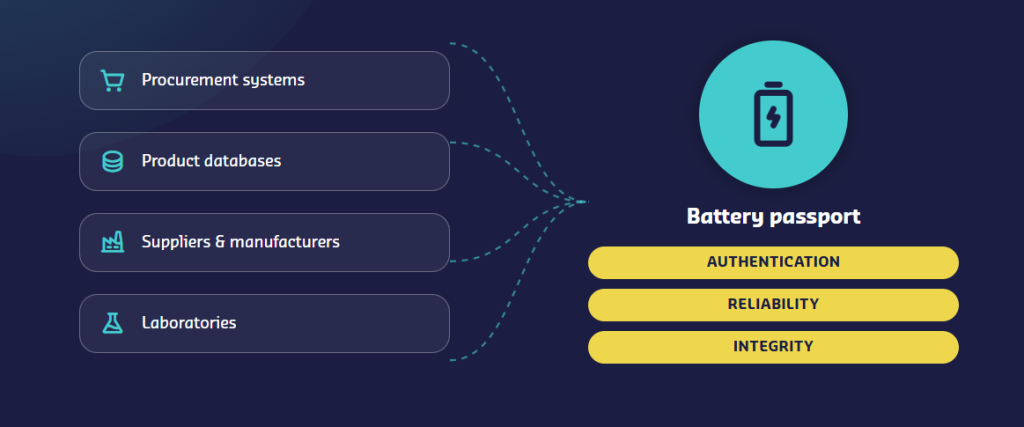
Companies may already hold much of the required information, but it can be spread across procurement systems, product databases, suppliers, manufacturers, laboratories and other parts of the value chain. Some information may be structured and readily available. Other data may still be exchanged through spreadsheets, documents or manual requests.
The challenge is therefore not simply collecting more data. It is understanding what data exists, where it comes from, who owns it, how frequently it changes and what evidence supports it.
The Batteries Regulation makes this particularly important because the passport must ensure data authentication, reliability and integrity.
Before creating the passport, companies need to understand the quality of the information that will sit inside it, and whether they can obtain and maintain that information consistently across the value chain.
Look beyond the first tier of suppliers
Some of the most important battery information does not originate with the company placing the final product on the market.
Material composition, critical raw materials, recycled content, carbon footprint and responsible sourcing information can depend on data coming from different actors across the supply chain. The further upstream the information sits, the harder it can become to obtain consistently and verify.
This makes value-chain mapping and supplier engagement central to DPP readiness.
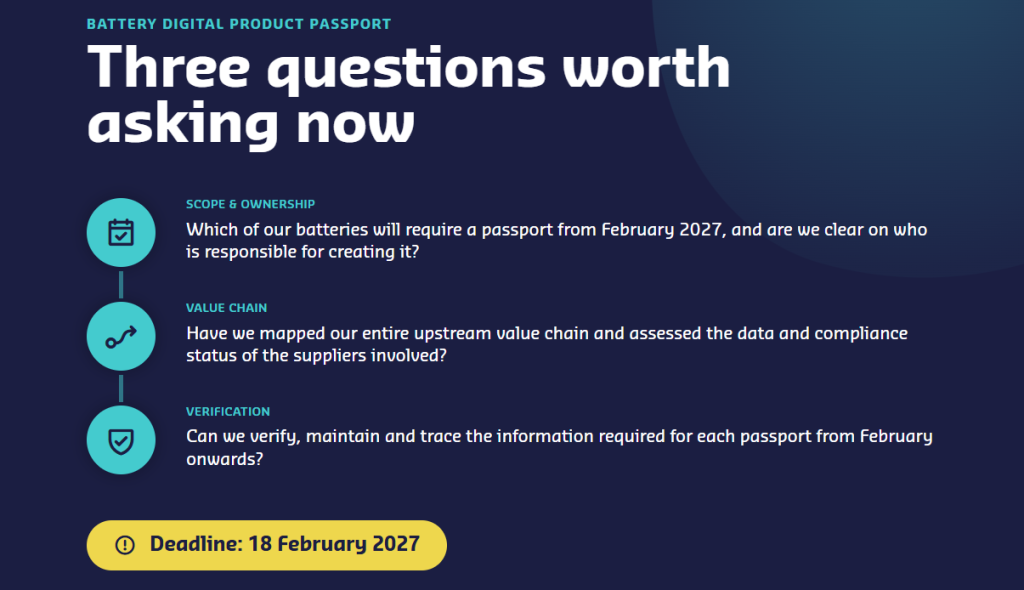
Companies need to know which suppliers and upstream actors hold which information, what format it is available in, whether supporting evidence exists and, critically, where each supplier stands in terms of compliance.
A complete view of the upstream value chain can reveal where information is missing, where evidence is insufficient and which suppliers may represent a compliance risk before February.

From testing readiness to proving readiness
With the February 2027 deadline only months away, testing whether a single product can support a passport is no longer enough.
Companies with an obligation to create a Battery Passport need to be confident that they can meet the requirements from day one.
That means moving beyond a pilot and establishing a clear view of the entire upstream value chain. Companies should know:
- Which batteries and battery models are in scope
- Which data is required for each
- Where that information comes from
- Which suppliers are able to provide it
- What evidence supports it
- Where compliance gaps remain
The objective should be to identify and close those gaps before the obligation takes effect, rather than discovering them when the first passports need to be issued.
For companies that have not yet started, there is still time to prepare, but the starting point should be now.
Build a product record, not just a compliance file
The battery passport should not become another isolated regulatory database.
The information required for the passport can overlap with data companies may already need for other sustainability, product and supply-chain requirements. Material information, carbon footprint data, responsible sourcing, recycled content and lifecycle information can all have value beyond the passport itself.
The EU Batteries Regulation also requires the battery passport to be interoperable with other Digital Product Passports required under EU law, covering technical, semantic and organisational aspects of data communication and transfer.
That points to a broader opportunity.
Rather than creating separate datasets for every regulation, companies can work toward a single, structured and traceable product data foundation that can support multiple requirements.
Think about the data lifecycle, not just the deadline
A battery passport is not a document that is created once and forgotten.
The regulation requires information relating to individual batteries to reflect changes over their lifecycle, including performance and durability parameters, state of health, status and certain data resulting from use.
That means companies need to think about data maintenance as well as data collection:
- Who updates the passport when a battery changes status?
- How is information validated?
- How are changes recorded?
- Who can access or modify different types of information?
- How can the company make sure that the information remains available and reliable over time?
These questions are just as important as deciding what technology will host the passport.
Turn Battery Passport preparation into supply chain readiness
The Battery Passport is an important step toward a more connected approach to product information in the EU. But meeting the requirement will depend on much more than generating a digital record.
Companies will need reliable data, visibility across the upstream value chain, stronger supplier engagement, clear ownership, traceable evidence and processes that can keep information accurate throughout the product lifecycle.