
The Real PPWR Bottleneck Isn’t Recycled Content – It’s Knowing Your Role

By Maria Baquero- ESG Project Leader
Over three weeks in September 2026, we ran PPWR (Packaging and Packaging Waste Regulation) online event in English, Spanish, and Portuguese. Together, they drew 431 registrants from more than 40 countries; everyone from textile manufacturers and food producers to retailers and private-label brands trying to figure out where they stand under the new regulation.
We didn’t just present. We polled attendees during the sessions and left the floor open for questions. That gave us two independent data sets on the same audience: what people say is hardest, and what they actually ask about when they have a live expert in front of them.
Here’s the short version of what we found:
- Half of the companies in our sample either haven’t heard of PPWR in any real detail or have only just started assessing its impact.
- 40% haven’t even started evaluating their packaging yet.
- When asked directly, companies say recycled content and technical documentation are their biggest headaches.
- But when they actually get to ask a question live, nearly 4 in 10 questions — more than anything else combined, boil down to one thing: “Wait, are we even the manufacturer here?”
In other words, most companies think their problem is paperwork or recycled-content percentages. The real problem, for a lot of them, is one step earlier: they don’t know which role they hold in the supply chain, or whether PPWR applies to them at all. That’s what this article is about the data behind it, why it happens, and a practical way to start answering it for your own organization.
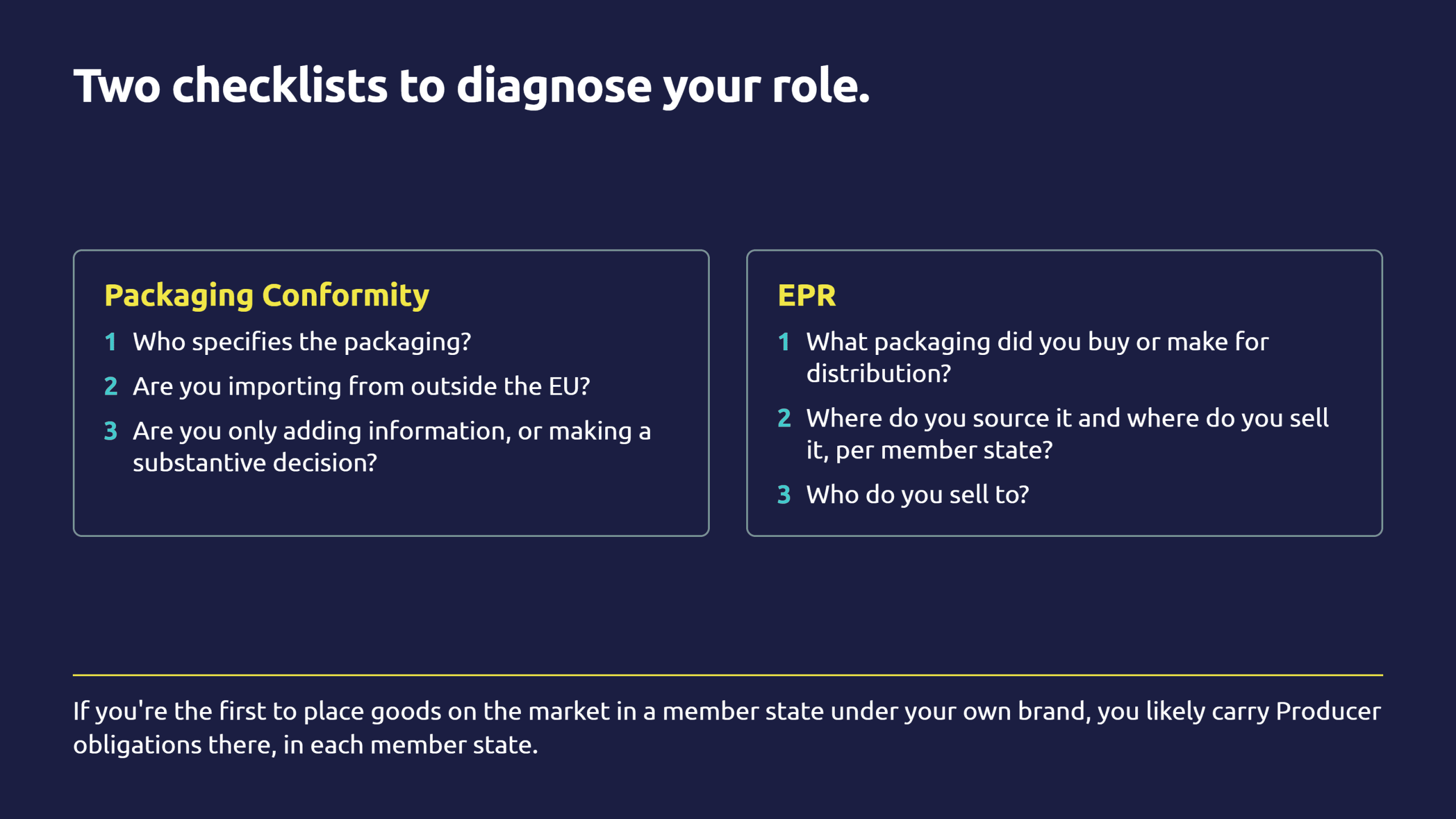
Before diving into recycled-content thresholds or technical documentation templates, it’s important to understand that PPWR imposes two distinct sets of responsibilities: Packaging Conformity (ensuring the packaging itself meets regulatory requirements) and Extended Producer Responsibility or EPR (managing packaging waste after the product is sold). Many companies conflate producer responsibilities under these two systems, but they are separate frameworks.
What PPWR Actually Requires, in Brief
Before getting into the data, a quick baseline, since a lot of the confusion starts here.
The PPWR — Regulation (EU) 2025/40 — is the EU’s new, directly binding rule on packaging and packaging waste. Unlike the directive it replaces, a regulation applies the same way in every member state without needing to be transposed into national law first, which is part of why so many companies are only now realizing it applies to them. It entered into force on 11 February 2025 and became generally applicable on 12 August 2026.
It touches the entire value chain: material and component suppliers, manufacturers and brand owners, importers, retailers and distributors. If your packaging reaches the EU market in any way, you’re very likely in scope.
The obligations phase in over several years:
- 2026 — general application begins; PFAS restrictions in food-contact packaging apply.
- 2027 — EU member states must have national penalties in place.
- 2028 (or 2 years after the publication of the execution acts in which a harmonized label and labelling specifications will be established) — the harmonized labelling specifications will need to be met.
- 2030 — all packaging must meet minimum recyclability grades, plastic packaging must contain minimum recycled content (ranging roughly 30–65% depending on the format), and the first reuse targets kick in.
- 2038 — the lowest recyclability grade is phased out entirely.
- 2040 — reuse targets increase further.
Non-compliance isn’t just a fine on paper. Packaging that doesn’t meet the requirements can be blocked or withdrawn from the EU market outright, and penalties are set nationally in Spain, for example, the most serious breaches can reach into the millions of euros. Beyond that, more retailers and buyers are already asking suppliers to prove PPWR readiness before placing orders, so this is increasingly a commercial gatekeeping issue, not just a legal one. For a fuller breakdown of the obligations and timeline, our PPWR overview covers it in more depth.
With that context, the survey and Q&A data starts to make a lot more sense.
Most Companies Are Further Behind Than They Think
Across the three webinars, only 12% of respondents already have a PPWR compliance strategy in place. Just over half either had never heard of the regulation or had heard the name without knowing what it actually requires.
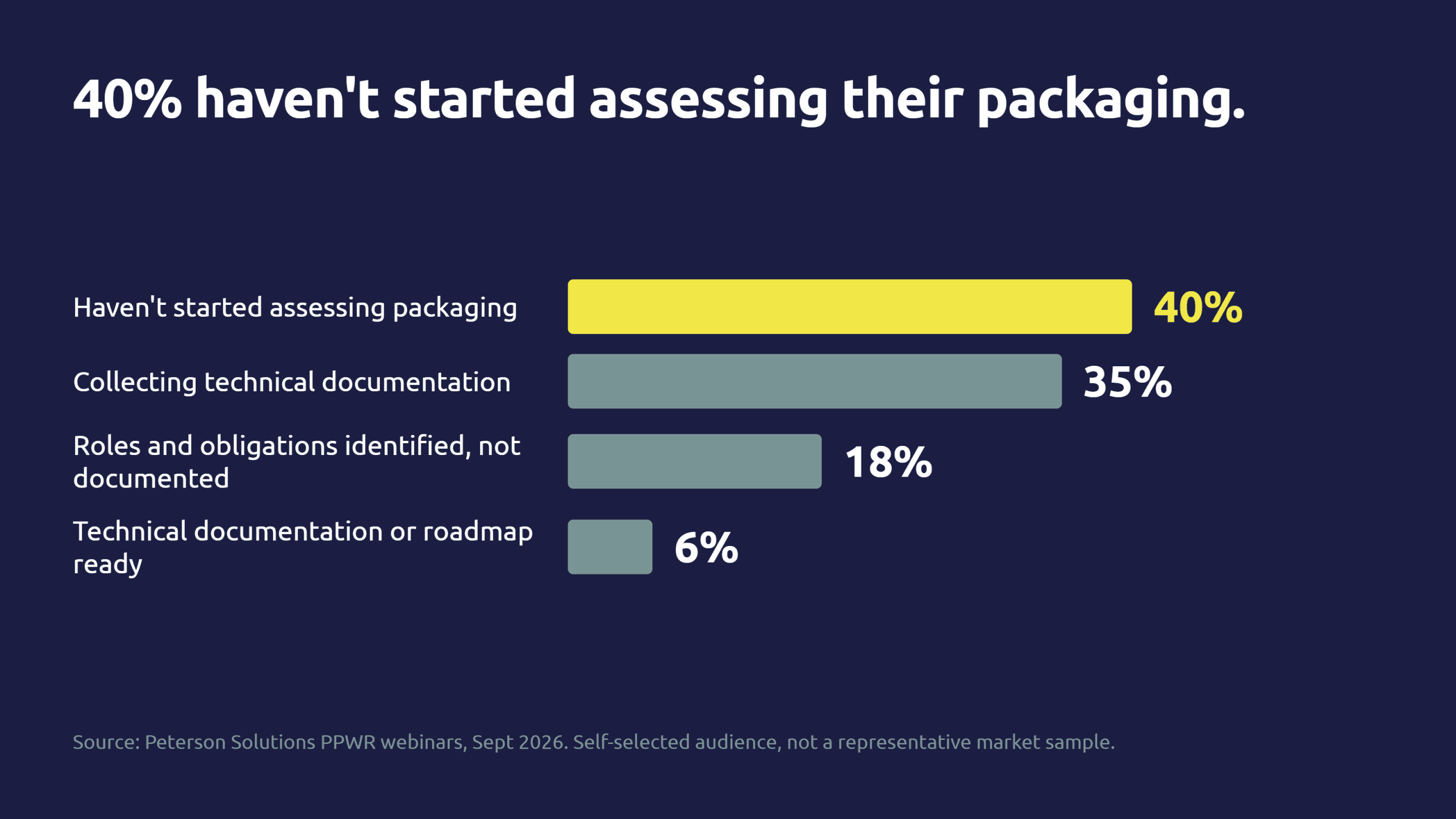
The preparation numbers tell the same story from a different angle: 40% of respondents haven’t started assessing their packaging at all, and only 6% have technical documentation or a compliance roadmap ready. Another 35% are actively collecting technical documentation, and 18% have identified their roles and obligations but haven’t started documenting anything yet.
Given that obligations are now phasing in and the 2030 thresholds aren’t far off in packaging-development timelines, that’s a wide gap between where companies need to be and where most of them currently are and it explains why turnout across three languages was as high as it was.
What People Say Is Hardest — Versus What They Actually Ask
We asked attendees directly, via poll, which part of PPWR they expected to be most challenging. The top answers were close to a three-way tie:
- Collecting recycled-content and recyclability evidence from suppliers — 28%
- Preparing technical documentation and EU Declarations of Conformity — 27%
- Determining their exact role(s) across different packaging formats — 23%
- Meeting the 2030 recyclability grade and recycled-content thresholds — 15%
- EPR registration and annual reporting across member states — 6%
On paper, “figuring out my role” looks like the third-biggest concern, behind supplier data and paperwork.
Then we looked at what people actually asked, live, when the floor opened. Across all three sessions, 44 questions came in. Seventeen of them — 39%, nearly four in ten, and by a wide margin the single largest category — were some version of the same question: Are we the manufacturer, the producer, the importer, or the distributor?
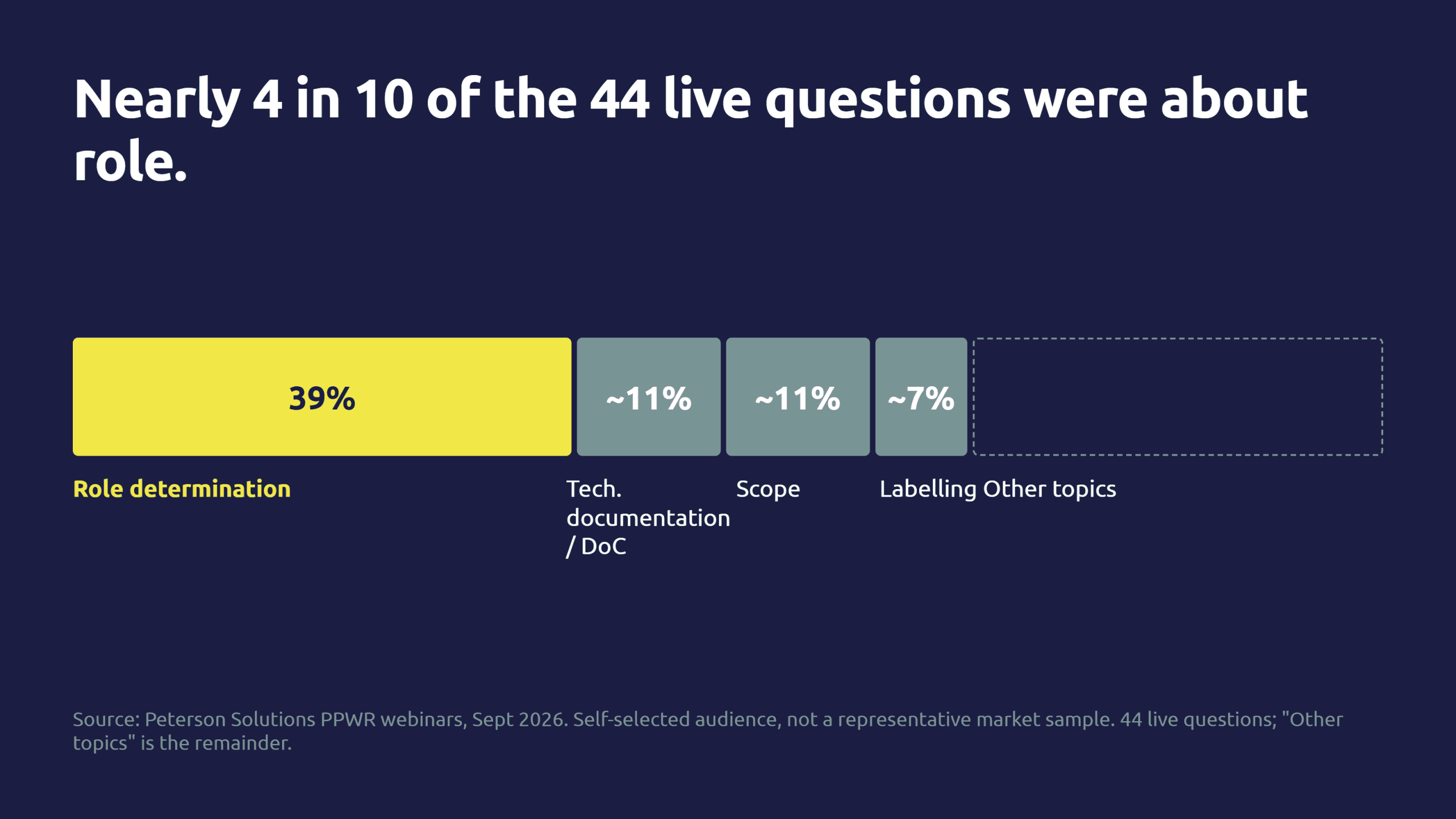
No other topic came close. Questions about technical documentation and Declarations of Conformity accounted for about 11%. Labeling questions were around 7%. Scope and applicability questions were another 11%.
That’s the gap worth paying attention to. When people fill out a survey in the abstract, recycled content and paperwork feel like the hard parts. But the moment they try to apply PPWR to their actual supply chain, role determination is what stops them cold far more often than anything else.
Until you clearly understand your role, you cannot determine whether you are responsible for preparing the EU Declaration of Conformity, maintaining the required technical documentation, and making it available to other operators in the value chain or whether your role is primarily to verify the documentation provided by upstream operators.
It also makes sense as a root cause rather than a separate issue. You cannot know which technical file you need, which declaration you’re responsible for signing, or which recycled-content threshold applies to you until you know which role you hold. Role confusion doesn’t compete with the documentation and recycled-content challenges — it sits underneath them. Fix the role question, and a lot of the “harder” problems either resolve themselves or become much narrower.
Why Role Determination Is Genuinely Confusing Under PPWR
The live questions weren’t generic ; they came from real, specific situations, and the pattern behind them is consistent:
Private label and contract manufacturing. A company that designs and orders packaging under a client’s brand, but doesn’t physically manufacture it, repeatedly asked whether that makes them the “manufacturer.” Several attendees who supply finished goods under a retailer’s own brand asked whether they count as the Producer under Extended Producer Responsibility (EPR) rules.
Multi-role supply chains. More than one attendee runs a business that is a manufacturer for some product lines (because they specify the material and format) and simply a distributor for others (because they buy ready-made packaging off the shelf) — and wanted to know if both roles can apply within the same company at once.
Importers who only add a label. Several questions centered on whether adding required contact and identification information to packaging without altering the packaging itself , is enough to make an importer the legal manufacturer.
Logo and branding ambiguity. One recurring question: if a company’s logo appears on packaging it didn’t design or produce, does that alone create manufacturer-level responsibility?
Cross-border reporting. Multiple attendees who sell under their own brand in several EU member states asked who is responsible for Producer registration, and in which country it has to happen, echoing a broader Q&A theme about EPR obligations applying separately, member state by member state.
None of these are edge cases. They’re the normal reality of how packaged goods move through modern supply chains: private label, multi-market distribution, and mixed manufacturing, which is exactly why the question comes up so often. It’s also why PPWR treats importers as producers by default, and why anyone marketing goods under their own brand effectively takes on manufacturer-level obligations, even if they never touch the packaging line themselves.
A Note on Current Regulatory Uncertainty
At present, there is some misalignment in how the European Commission defines “Producer” across its three main interpretive documents on PPWR. While the Commission’s FAQs and Guidance Document treat a company’s distribution of packaging or packaged goods under its own brand as a relevant factor in determining producer status, the regulation text itself (Article 3(15)) does not explicitly reference brand ownership.
This creates a gap: depending on which Commission document an authority prioritizes, a company might or might not qualify as a Producer, what has been referred to as the problem of “Schrödinger’s Producer.”
Until this alignment improves, companies are advised to document their analysis against all three sources and, where uncertainty exists, seek guidance from national competent authorities or external counsel.
What This Means for the Next Few Months
If your organization hasn’t already mapped its role across every packaging format it uses, you’re not behind some unusual curve; you’re in the majority. Over half of the companies in this sample are at the same starting point.
But the data also suggests a clear order of operations: resolve role determination first, before investing heavily in recycled-content tracking or technical documentation systems. Getting the role question wrong means redoing the downstream work — the technical documentation, the declarations, the EPR registrations — once the correct role is identified. Getting it right first narrows everything that follows into something much more manageable.
If you’d rather talk it through than map it alone, our PPWR specialists can help you pin down your exact role and obligations before you invest in the rest.
This analysis is based on poll responses and live Q&A from three PPWR webinars held in September 2026 (English, Spanish, and Portuguese), covering 431 registrants across more than 40 countries. It reflects a self-selected audience of companies proactively seeking PPWR guidance, not a randomized market sample — but the consistency of the pattern across three separate languages and audiences is exactly what makes it worth acting on.